

Introduction
Dog bloat is a serious condition that affects a dog’s stomach. The stomach fills up with gas, food, or fluid and becomes swollen. In some cases, the stomach also twists on itself. When this happens, the condition is called GDV, which stands for Gastric Dilatation and Volvulus. GDV cuts off blood flow to the stomach and other organs. It is one of the most dangerous emergencies a dog can face.
Most dog owners have never heard of bloat until it happens to their own pet. By the time the signs show up, the situation can already be critical. A dog that seemed perfectly fine in the morning can be fighting for its life by evening. That is what makes bloat so frightening. It moves fast and gives you little time to act.
This article covers everything you need to know about dog bloat. You will learn what causes it, which dogs are most at risk, and what the warning signs look like. You will also find out what to do if you suspect your dog has bloat and how vets treat it. Whether you are a new dog owner or have had dogs for years, understanding bloat could save your pet’s life.
What Is Dog Bloat (GDV)?
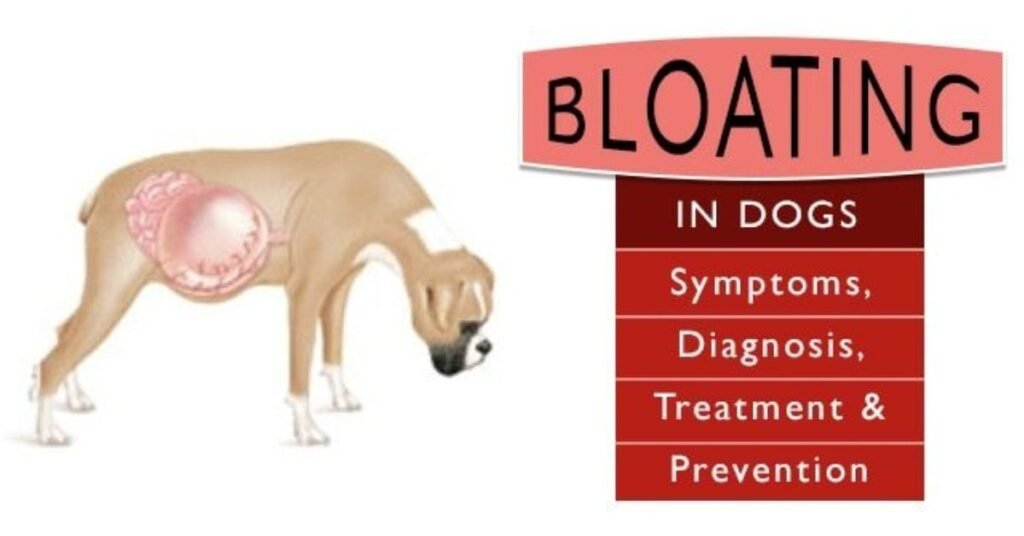
Dog bloat happens when a dog’s stomach fills with gas, food, or liquid and expands beyond its normal size. This expansion puts pressure on the surrounding organs and makes it hard for the dog to breathe. In some cases, the swollen stomach rotates or twists inside the abdomen. When that twist occurs, the condition becomes GDV, which stands for Gastric Dilatation and Volvulus. Blood flow to the stomach gets cut off almost immediately. Without treatment, the tissue begins to die within hours.
GDV is not the same as regular stomach bloating in humans. Instead, it is a life-threatening medical emergency that requires surgery in most cases. The twisted stomach traps gas inside and prevents the dog from relieving the pressure by vomiting or burping. As a result, the abdomen becomes hard and visibly swollen. Additionally, blocked blood flow can quickly send the dog into shock. That is why getting to a vet as fast as possible is the only way to give your dog a real chance of survival.
How Is Bloat Different From Regular Stomach Upset?
Regular stomach upset in dogs is common and usually not dangerous. Your dog might eat something bad, skip a meal, or simply have a sensitive stomach that day. Most of the time, the discomfort passes on its own within a few hours. Bloat, however, does not go away on its own. Instead, it gets worse with every passing minute. The difference between the two can mean the difference between a simple vet visit and a life-threatening emergency.
A dog with regular stomach upset can still walk around and may even eat a little. A dog with bloat, on the other hand, looks deeply distressed and cannot get comfortable. Furthermore, the belly in bloat cases feels tight like a drum when you press it gently. Additionally, a dog with regular upset will vomit and feel relief afterward. With bloat, the dog tries to vomit repeatedly, but nothing comes out. Therefore, if you notice that sign, treat it as an emergency and head to the vet immediately.
| Feature | Regular Stomach Upset | Bloat (GDV) |
| How it starts | Gradually, after eating something bad | Suddenly, often without warning |
| Vomiting | Vomits and feels relief | Tries to vomit but cannot |
| Belly appearance | Normal or slightly soft | Visibly swollen and hard |
| Energy level | Tired but still moving | Restless, weak, or collapsing |
| Breathing | Normal | Rapid or labored |
| Pain level | Mild discomfort | Obvious and severe pain |
| Passes on its own | Yes, within hours | No, gets worse quickly |
| Requires surgery | No | Often yes |
| Risk to life | Low | Extremely high |
| What to do | Monitor at home | Go to the vet immediately |
Early Warning Signs of Bloat in Dogs
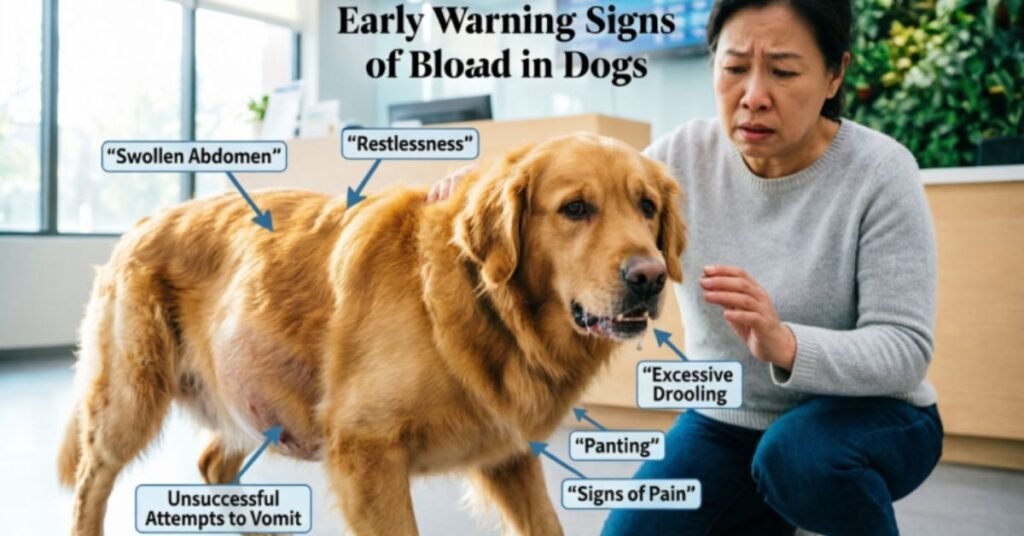
Catching bloat early can save your dog’s life. The first signs are easy to miss because they can look like ordinary discomfort. Your dog may start pacing around the house without settling down. Additionally, you might notice your dog staring at its belly or trying to bite at it. Restlessness combined with a loss of appetite is a strong early warning. Therefore, never ignore these signals, even if your dog seems only mildly uncomfortable.
Physical signs become more obvious as bloat progresses. Furthermore, the belly may start to look rounder or feel harder than usual when you touch it. Your dog might try to vomit repeatedly but bring nothing up. Breathing can also become faster or shallower than normal. Moreover, excessive drooling and a hunched posture are signs that something is seriously wrong. If you spot more than one of these signs together, get to a vet without delay.
Early warning signs to watch for:
- Pacing and inability to settle or lie down comfortably
- Repeated attempts to vomit with nothing coming out
- A swollen, round, or hard feeling in the belly
- Staring at, licking, or biting the abdomen
- Excessive drooling more than usual
- Rapid or shallow breathing
- Hunched back or stiff body posture
- An abrupt loss of interest in food or water
- Pale or white colored gums
- Weakness or reluctance to move
Restlessness and Discomfort
Restlessness is one of the earliest and most telling signs of bloat in dogs. Your dog may pace from room to room without lying down for more than a few seconds. Additionally, it might keep standing up and sitting back down repeatedly, unable to find a comfortable position. Some dogs will whine or groan quietly, which is their way of showing they are in pain. Furthermore, a dog in this state will often refuse treats or food, which is unusual for most dogs. Therefore, if your dog cannot settle and seems visibly uneasy, take it seriously right away.
Discomfort from bloat is not like the mild unease of an upset stomach. The pain builds quickly and becomes harder for the dog to hide. Moreover, you may notice your dog stretching into a prayer position, with its front legs down and its back end raised. That posture is a clear sign that the abdomen is causing significant pain. Additionally, some dogs will turn around and look at their belly repeatedly, as if confused by the discomfort. Therefore, any combination of these behaviors alongside a swollen belly means it is time to act fast.
| Behavior | What It Looks Like | What It Means |
| Pacing | Walking back and forth without stopping | Unable to find relief from pain |
| Repeated sitting and standing | Getting up and down constantly | Trying to ease abdominal pressure |
| Whining or groaning | Soft, repeated vocalizations | Expressing pain without an obvious cause |
| Prayer position | Front legs down, rear end up | Relieving pressure on the stomach |
| Looking at the belly | Turning the head toward the abdomen repeatedly | Reacting to internal discomfort |
| Refusing food | Ignoring treats or meals | Pain overrides normal appetite |
| Inability to settle | Cannot lie still for more than seconds | Discomfort worsens in resting positions |
| Drooling heavily | Excessive saliva with no food present | Nausea caused by stomach distension |
| Shallow breathing | Short, rapid breaths | Swollen stomach pressing on the diaphragm |
| Restless eyes | Wide, anxious-looking expression | Stress response to severe discomfort |
Swollen or Hard Abdomen
A swollen or hard abdomen is one of the most visible signs that something is seriously wrong. Your dog’s belly may look noticeably larger than normal, especially on the left side just behind the rib cage. Additionally, when you gently press on the stomach area, it may feel tight and drum-like instead of soft. This happens because trapped gas has built up inside with nowhere to escape. Furthermore, the swelling can appear quite suddenly, even within an hour of eating. Therefore, checking your dog’s belly when something feels off is always a good idea.
Not every case of bloat will show extreme visible swelling right away. Moreover, dogs with thicker coats or larger body frames can make the swelling harder to spot. Running your hands along the sides of your dog’s abdomen is a more reliable check than just looking. Additionally, a healthy belly should feel soft and give slightly when pressed gently. If it feels rigid or causes your dog to flinch, those are serious red flags. Therefore, trust what you feel with your hands just as much as what you see.
| Abdomen Sign | What It Looks Like | What It Indicates |
| Visible swelling | Belly looks larger than normal | Gas buildup inside the stomach |
| Left side bulge | Enlargement behind the left rib cage | Classic early sign of GDV |
| Hard to the touch | Belly feels tight and rigid | Stomach distension from trapped gas |
| Drum-like sound | Hollow sound when the belly is tapped | Gas-filled stomach under pressure |
| Flinching when touched | Dog pulls away or whines | Pain from abdominal pressure |
| Asymmetrical shape | One side larger than the other | Stomach twisting causing uneven swelling |
| No relief after retching | Swelling remains after vomiting attempts | Stomach twist preventing gas release |
Excessive Drooling and Pale Gums
Excessive drooling in dogs is not always a sign of hunger or excitement. When a dog has bloat, nausea builds up quickly and triggers heavy salivation. Additionally, the dog may drool in thick strings or pools without any food being present nearby. This type of drooling comes on suddenly and does not stop on its own. Furthermore, it is often accompanied by repeated swallowing or lip licking, which are also signs of nausea. Therefore, sudden and heavy drooling alongside other symptoms should never be brushed off.
Pale gums are one of the most serious warning signs of bloat. Healthy dog gums should look pink and feel moist when you touch them. Moreover, pale, white, or grayish gums mean that blood circulation is being affected. This happens because the twisted stomach puts pressure on major blood vessels and restricts normal flow. Additionally, if you press on the gums and the color takes longer than two seconds to return, that is a sign of poor circulation. Therefore, checking your dog’s gums takes only seconds but can tell you a great deal about how serious the situation is.
| Sign | What It Looks Like | What It Means |
| Heavy drooling | Thick strings of saliva without food present | Nausea from stomach distension |
| Repeated swallowing | Constant gulping with nothing in mouth | Trying to manage rising nausea |
| Lip licking | Frequent licking of lips and nose | Early sign of nausea and discomfort |
| Pale gums | Gums appear white or light pink | Reduced blood circulation |
| Gray or blue gums | Gums take on a dull gray or blue tone | Severe circulation failure or shock |
| Slow capillary refill | Color takes over two seconds to return after pressing | Poor blood flow to tissues |
| Dry gums | Gums feel tacky or dry instead of moist | Dehydration combined with circulatory stress |
Mild vs. Severe Bloat Symptoms
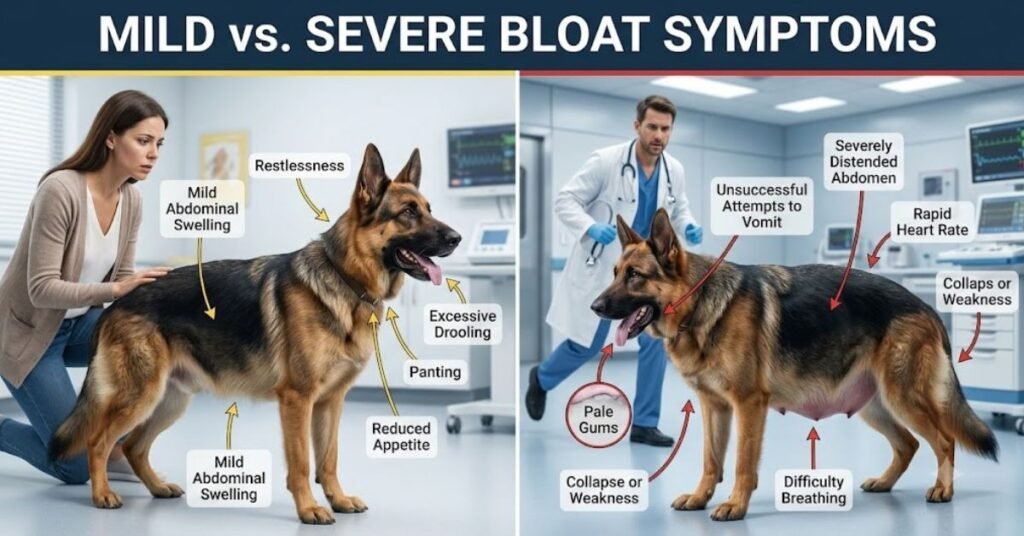
Bloat does not always start with dramatic or obvious signs. In the early stage, your dog may simply seem restless, uncomfortable, or uninterested in food. Additionally, the belly might feel slightly firmer than usual without looking visibly swollen yet. These mild signs are easy to dismiss as a regular stomach issue. Furthermore, that is exactly what makes early-stage bloat so dangerous, because many owners wait too long to act. Therefore, even mild symptoms deserve immediate attention when they appear together.
Severe bloat is impossible to miss once it takes hold. At this stage, the belly is also visibly distended and hard to touch. Your dog may collapse, struggle to breathe, or go into shock without warning. Additionally, the gums turn pale or grayish, and the dog becomes too weak to stand properly. Furthermore, attempting to vomit repeatedly with nothing coming out is a hallmark sign of severe GDV. Therefore, if your dog reaches this stage, every single minute counts and emergency care is the only option.
| Symptom | Mild Bloat | Severe Bloat |
| Belly appearance | Slightly firm or mildly rounded | Visibly swollen and hard as a drum |
| Vomiting attempts | Occasional unproductive retching | Repeated and constant retching |
| Energy level | Restless but still standing | Weak, collapsing, or unable to rise |
| Gum color | Normal pink | Pale, white, or grayish |
| Breathing | Slightly faster than normal | Rapid, shallow, and labored |
| Pain level | Mild and easy to miss | Severe and visibly obvious |
| Drooling | Slightly more than usual | Heavy and continuous |
| Response to touch | Mild flinching on belly | Strong pain reaction when touched |
| Time to act | Urgent, go to vet quickly | Emergency, every minute matters |
| Risk to life | High if ignored | Extremely critical without surgery |
When Is It a Life-Threatening Emergency?
Bloat becomes a life-threatening emergency the moment the stomach twists. At that point, blood flow to the stomach and surrounding organs gets cut off completely. Additionally, toxins begin building up in the body within minutes of the twist occurring. Your dog’s condition can go from uncomfortable to critical in under an hour. Furthermore, the heart can also be affected, leading to dangerous and irregular heartbeats. Therefore, a twisted stomach is not something that can wait until morning or the next available appointment.
Certain signs tell you that your dog has crossed into emergency territory. Collapsing or being unable to stand is one of the clearest indicators of a critical situation. Moreover, pale or gray gums signal that the body is already going into shock. Rapid and labored breathing means the swollen stomach is pressing against the lungs. Additionally, a belly that looks severely distended and feels rock hard confirms that the situation is dire. Therefore, the moment you see these signs together, skip the phone call and drive straight to the nearest emergency vet.
Which Dogs Are Most at Risk?
Bloat can happen to any dog, but some are far more vulnerable than others. Large and giant breed dogs with deep, narrow chests are at the highest risk. Additionally, the shape of their chest creates more room for the stomach to shift and twist. Breeds like Great Danes, German Shepherds, and Dobermans are among the most commonly affected. Furthermore, older dogs tend to be more at risk than younger ones due to weaker stomach ligaments. Therefore, if you own a large breed dog, understanding this risk is especially important.
Lifestyle and eating habits also play a significant role in a dog’s risk level. Moreover, dogs that eat one large meal a day are more prone to bloat than those fed smaller portions. Eating too fast, drinking large amounts of water quickly, and exercising right after meals all increase the risk. Additionally, dogs with a nervous or anxious temperament have been found to develop bloat more frequently. Furthermore, a family history of bloat in a dog’s bloodline raises the risk even higher. Therefore, knowing your dog’s breed, habits, and history helps you take the right preventive steps.
Dogs most at risk:
- Great Danes, German Shepherds, Dobermans, and Weimaraners
- Deep-chested and large breed dogs in general
- Dogs that eat one large meal daily
- Fast eaters that gulp food and air together
- Dogs that exercise immediately after eating
- Older dogs above seven years of age
- Dogs with a family history of bloat
Breed and Body Size
Breed and body size are two of the strongest predictors of bloat risk in dogs. Large and giant breeds with deep, narrow chests are built in a way that gives the stomach more room to move and twist. Additionally, the stomach in these dogs sits more loosely in the abdominal cavity than it does in smaller breeds. This loose positioning makes it easier for the stomach to rotate when filled with gas or food. Furthermore, studies have shown that a dog’s chest depth to width ratio is one of the biggest physical risk factors. Therefore, the deeper and narrower the chest, the higher the risk of bloat.
Smaller breeds are not completely immune, but their risk is significantly lower. Moreover, their compact body structure keeps the stomach more firmly in place. Mixed breed dogs can also develop bloat if they carry the deep-chested body shape. Additionally, even within high-risk breeds, individual body shape can vary and affect overall risk level. Furthermore, male dogs tend to develop bloat more often than females across most large breeds. Therefore, knowing your dog’s breed and physical build gives you a clearer picture of how closely you need to monitor them.
| Breed | Size | Chest Type | Risk Level |
| Great Dane | Giant | Very deep and narrow | Extremely high |
| German Shepherd | Large | Deep and moderately narrow | Very high |
| Doberman Pinscher | Large | Deep and lean | Very high |
| Weimaraner | Large | Deep and athletic | Very high |
| Standard Poodle | Large | Deep and slender | High |
| Irish Setter | Large | Deep and long | High |
| Boxer | Large | Deep and broad | Moderate to high |
| Labrador Retriever | Large | Moderate depth | Moderate |
| Basset Hound | Medium | Low and wide | Moderate |
| Chihuahua | Small | Shallow and compact | Low |
What to Do When You Notice Bloat Symptoms
Noticing bloat symptoms in your dog means one thing: act immediately. Every minute you wait gives the condition more time to worsen and cause irreversible damage. Additionally, do not try to treat bloat at home with remedies or by making your dog walk it off. There is nothing you can do at home that will stop or reverse what is happening inside. Furthermore, do not wait to see if the symptoms improve on their own, because with bloat they will not. Therefore, the only right action is to get your dog to an emergency vet as fast as possible.
Staying calm is important because your dog can sense your panic and become more distressed. Moreover, call the vet clinic ahead while someone else drives so they can prepare for your arrival. Do not let your dog eat or drink anything on the way to the clinic. Additionally, keep your dog as still and comfortable as possible during the journey. Furthermore, note the time when symptoms first appeared, as this information helps the vet assess how far the condition has progressed. Therefore, being observant and prepared in those critical moments can genuinely improve your dog’s chances of survival.
What to do immediately:
- Stop all food and water right away
- Call the emergency vet while heading there
- Keep your dog calm and as still as possible
- Note when symptoms first started
- Do not attempt home remedies of any kind
- Drive directly to the nearest emergency animal clinic
- Inform the vet about your dog’s breed, age, and symptoms upon arrival
How Vets Diagnose and Treat Bloat in Dogs
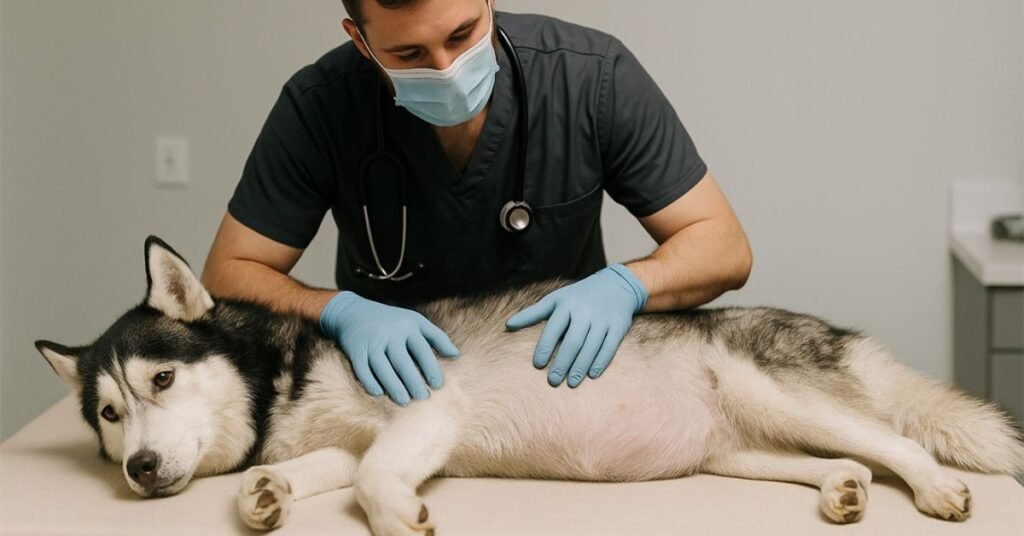
Vets diagnose bloat quickly because time is critical from the moment a dog arrives. A physical examination of the abdomen is usually the first step in the process. Additionally, an X-ray is taken to confirm whether the stomach is simply distended or has also twisted. The X-ray image shows a distinctive double bubble shape when GDV is present. Furthermore, blood tests are run alongside imaging to check organ function and assess shock levels. Therefore, diagnosis in most cases happens within minutes of the dog reaching the clinic.
Treatment begins immediately, even before surgery in most cases. Moreover, the vet will stabilize the dog first by administering intravenous fluids to treat shock. A tube may be passed through the mouth into the stomach to release trapped gas and relieve pressure. Additionally, pain relief and heart medications are given if irregular heartbeats are detected. Furthermore, once the dog is stable enough, emergency surgery is performed to untwist the stomach and secure it in place. Therefore, the speed of both diagnosis and treatment directly determines whether the dog survives.
Steps vets take to diagnose and treat bloat:
- Physical examination of the abdomen for swelling and pain
- X-ray imaging to confirm distension or stomach twist
- Blood tests to evaluate organ function and shock
- Intravenous fluids to stabilize blood pressure
- Stomach tube insertion to release trapped gas
- Pain relief and cardiac medications as needed
- Surgery to untwist and reposition the stomach in an emergency
- Gastropexy procedure to permanently prevent future twisting
What Happens During Emergency Treatment?
Emergency treatment for bloat begins the second your dog enters the clinic. The veterinary team moves fast because every minute without intervention increases the risk of organ damage. Additionally, the priority is stabilizing your dog’s condition before anything surgical is attempted. Intravenous fluids are started immediately to restore blood pressure and treat shock. Furthermore, oxygen may be provided if your dog is struggling to breathe properly. Therefore, the first phase of treatment is entirely focused on keeping your dog alive and stable enough for surgery.
Once stabilized, the surgical phase begins without much delay. Moreover, the surgeon opens the abdomen to assess the condition of the stomach and surrounding tissue. Any tissue that has died due to restricted blood flow is carefully removed during this stage. Additionally, the stomach is untwisted and returned to its correct position inside the abdominal cavity. Furthermore, a procedure called gastropexy is performed to stitch the stomach wall to the abdominal lining, preventing it from twisting again in the future. Therefore, dogs that survive emergency surgery and gastropexy have a significantly lower chance of experiencing bloat again.
How to Prevent Bloat in Dogs
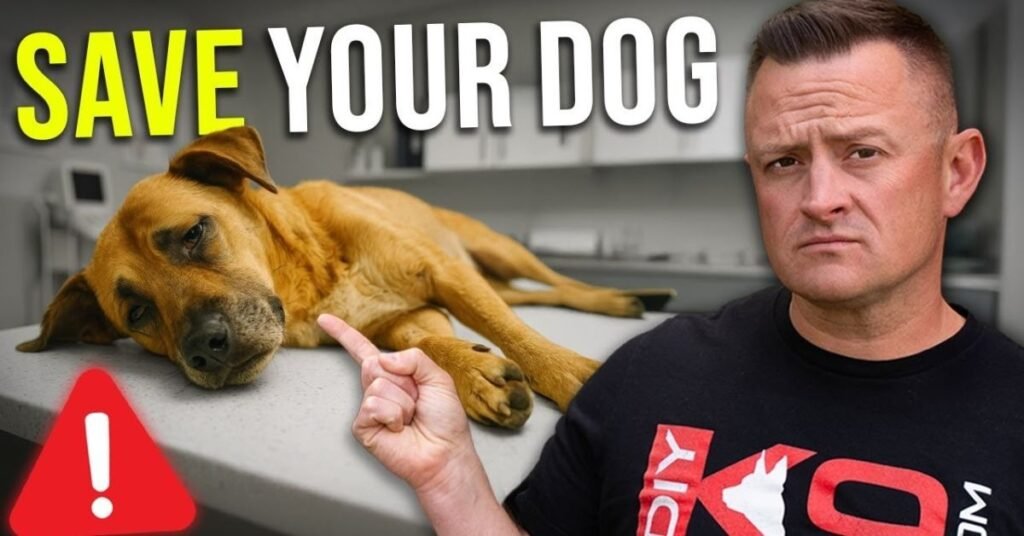
Preventing bloat starts with making small but meaningful changes to your dog’s daily routine. Feeding your dog two or three smaller meals throughout the day instead of one large meal reduces stomach overload significantly. Additionally, using a slow feeder bowl helps dogs that tend to eat too fast and swallow excess air. Exercise should always be avoided for at least an hour before and after meals. Furthermore, raised food bowls were once recommended but are now considered a potential risk factor for large breeds. Therefore, keeping the bowl at ground level is the safer choice for most dogs.
Stress and anxiety also contribute to bloat risk in ways many owners overlook. Moreover, dogs that are nervous or easily anxious tend to gulp air more frequently during eating and drinking. Feeding your dog in a calm and quiet environment helps reduce this habit. Additionally, limiting large water intake immediately after meals lowers the risk of the stomach expanding too quickly. Furthermore, high-risk breeds like Great Danes and German Shepherds can benefit from a preventive gastropexy procedure performed during routine surgery. Therefore, speaking with your vet about your dog’s individual risk level is always a smart and proactive step.
Practical prevention tips:
- Feed two to three small meals daily instead of one large one
- Use a slow feeder bowl to reduce air swallowing
- Avoid exercise for at least one hour after meals
- Keep the food bowl at ground level
- Limit large water intake right after eating
- Make sure your dog is fed in a calm, quiet environment
- Ask your vet about preventive gastropexy for high-risk breeds
Simple Daily Habits That Reduce the Risk
Small daily habits can make a real difference in keeping your dog safe from bloat. Splitting meals into two or three portions spread across the day is one of the simplest and most effective changes you can make. Additionally, always feeding your dog from a bowl placed on the ground rather than an elevated stand reduces unnecessary risk. Watching your dog eat and discouraging fast gulping saves them from swallowing large amounts of air. Furthermore, keeping mealtimes consistent helps regulate digestion and reduces stomach stress over time. Therefore, building these habits into your daily routine costs nothing but can protect your dog’s life.
Rest after meals is just as important as what your dog eats. Moreover, allowing at least one full hour of calm rest before any walk or playtime gives the stomach time to settle. Keeping water available throughout the day prevents your dog from drinking large amounts all at once. Additionally, feeding in a quiet space away from loud noises or other pets reduces stress during mealtimes. Furthermore, regularly checking your dog’s belly for any unusual firmness helps you catch early warning signs quickly. Therefore, staying observant and consistent with these habits is one of the best things you can do as a responsible dog owner.
Daily habits that lower bloat risk:
- Divide daily food into two or three smaller meals
- Always use a ground-level bowl for feeding
- Discourage fast eating with a slow feeder bowl
- Enforce one hour of rest after every meal
- Spread water intake evenly throughout the day
- Feed in a calm and quiet environment
- Check the belly regularly for unusual firmness or swelling
Can a Dog Survive Bloat Without Surgery?
Surviving bloat without surgery depends entirely on whether the stomach has twisted or not. Simple gastric dilatation, where the stomach is distended but has not twisted, can sometimes be managed without an operation. Additionally, a vet may be able to release the trapped gas using a stomach tube or needle decompression in mild cases. Furthermore, intravenous fluids and close monitoring may stabilize the dog without the need for immediate surgery. However, this is only possible in a very small number of cases caught extremely early. Therefore, assuming your dog can recover without surgery is a dangerous gamble that most vets would strongly advise against.
Once the stomach twists and GDV is confirmed, surgery is the only real option for survival. Moreover, no medication, home remedy, or non-surgical procedure can untwist a stomach once it has rotated. Without surgery, the tissue begins to die, toxins flood the bloodstream, and the dog goes into irreversible shock. Additionally, the survival rate drops dramatically with every hour that passes without surgical intervention. Furthermore, even with surgery, the outcome depends heavily on how quickly treatment was started after symptoms appeared. Therefore, the safest and most responsible approach is always to treat bloat as a surgical emergency from the very first sign.
Conclusion
Bloat is one of the most serious conditions a dog can face. It moves fast, causes immense pain, and can turn fatal within hours if left untreated. Additionally, what makes it especially dangerous is how quickly it shifts from mild discomfort to a life-threatening emergency. Therefore, every dog owner should know the basic signs and understand what they mean.
The warning signs are there if you know what to look for. A swollen belly, repeated unproductive retching, restlessness, and pale gums are all signals that something is seriously wrong. Furthermore, no single sign should be ignored when it appears alongside others. Therefore, trust your instincts and never wait to see if things improve on their own.
Prevention is always better than treatment when it comes to bloat. Moreover, simple daily habits like splitting meals, avoiding post-meal exercise, and feeding in a calm environment go a long way. Additionally, high-risk breed owners should speak with their vet about preventive gastropexy. Therefore, a few simple changes today can spare your dog from a painful and dangerous emergency down the road.
The person who knows your dog best is you, and that awareness is your most powerful tool. Furthermore, the more informed you are, the faster you can act when it matters most. Additionally, sharing this knowledge with other dog owners creates a wider safety net for pets everywhere. Bloat is frightening, but it is manageable when caught early and treated without delay. Therefore, stay observant, stay informed, and never underestimate what your dog is trying to tell you.
FAQs
Q1: Can bloat happen to small dogs?
Bloat is far more common in large breeds, but small dogs are not completely immune. Additionally, deep-chested small breeds like Dachshunds carry a slightly higher risk. Furthermore, fast eating and large water intake increase the risk in any dog regardless of size. Therefore, good feeding habits matter for all breeds.
Q2: How quickly does bloat progress in dogs?
Bloat can turn life-threatening in as little as one to two hours. Additionally, once the stomach twists, organ damage begins within minutes. Furthermore, waiting even a few hours to seek treatment reduces survival chances significantly. Therefore, acting at the very first sign is always the right decision.
Q3: Is bloat painful for dogs?
Bloat is extremely painful, particularly once the stomach expands and presses on surrounding organs. Additionally, dogs in this condition whine, pace, and cannot get comfortable. Therefore, any dog showing these signs needs immediate veterinary attention without delay.
Q4: Can bloat come back after surgery?
Standard surgery without gastropexy carries a high risk of bloat recurring in the future. Moreover, gastropexy reduces that risk to below five percent in most cases. Therefore, always ask your vet about combining both procedures during treatment.
Q5: What should I feed my dog to reduce bloat risk?
Feeding high-quality kibble in two or three small portions daily is a strong starting point. Additionally, using a slow feeder bowl prevents your dog from gulping air during meals. Therefore, simple and consistent feeding habits can make a meaningful difference in your dog’s safety.
